
As part of the APSU Computer Science Department’s internship requirement I was assigned to Geographic Information Systems Center (GIS Center). Apart from needing the course for graduation, it offers the student to contribute to worthy projects that benefit the university, and it gives the student a taste of a real-world working experience that can be legitimately used on a job resume. The projects the GIS will assign the student are not busy work, rather they’re offered for public use on the university’s website or other sites, for a specific audience and purpose.
A case in point, we were assigned a project to build a new website to help the US veteran, whether active duty, civilian, or retired, perform at least a partial self-assessment of the potential credit hour value of military training and off duty education the veteran accomplished throughout a military term of service. That service may have been decades ago or ongoing – it’s all worth something. The basic concept calls for the veteran to choose a branch of service from a dropdown menu and press submit like below;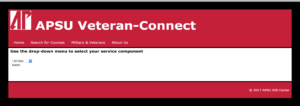 Once submit is pressed the veteran is presented with a new window that requests choice of a military occupational skill like this;
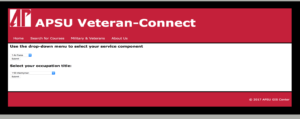 After the veteran submits his branch and skill set the website queries the connected database, also built by GIS in concert with student interns, to render the following result;
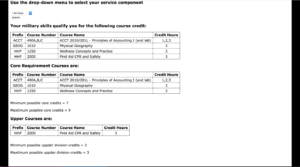 From a user standpoint, we wanted to offer usable results with as few clicks as possible. The course information provided is, either already approved or subject to approval by the university, and is based on the American Council on Education (ACE) recommendations and the Southern Association of Colleges and Schools standards (SACS). Where a minimum and maximum amount of credit hours possible is listed indicates that these can vary and must be taken up with an advisor to determine what, if any, the university will approve.
While the operation and presentation of the website is simple and easy to use, its construction was a bit complicated and it’s still a work in progress. It hasn’t been released for public use as of yet, but we hope that it’ll become a benchmark tool universities and colleges to use to help veterans get the credits they deserve and further their education to whatever level they wish to achieve.
So, with all that said let’s take a look at the building process of the database and the web application. We started from the concept that the university organizational structure would form the basis for the organization of the database tables containing courses offered from the different departments within each college and degree program. A college is made up of departments responsible for courses within a degree program. Since ACE makes recommendations about what types of study military experience and training equates to the table containing these bridges the gap between tables representing the university’s courses and the occupations within each military branch. While some credit can be nailed down immediately, some can’t because the credit value may vary depending on skill levels achieved while serving. Tables in the database relating to ACE connect tables relating military branch of service and military occupational codes that follow the recommendations provided by ACE, SACS, and approved by the university or those that would need to be worked through the advisement process. The diagram below shows the basic design, subject to change and adaptation, the we came up with for the best fit to our organization.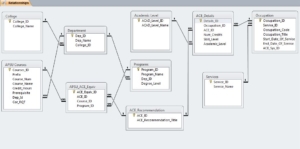 Improvements in the web application will include switching to a design that doesn’t reload each time a dropdown select and query is sent to the database to soften the workload on the server. Hopefully, that’s the design the will go into testing and finally release for public use. We hope to have the system running this year but the date is not firm at this time.

Leave A Comment
You must be logged in to post a comment.